When Does Endeavour Sponshorship Open Again Australia
| Australian of the Twelvemonth | |
|---|---|
 | |
| Awarded for | Contributing to positive change in the Australia |
| Sponsored by | Australia Postal service |
| Appointment | 26 January |
| Country | Australia |
| Presented by | National Australia Day Council |
| Motto | Reflect. Respect. Gloat. |
| First awarded | 1960 (1960) |
| Latest recipient | Dylan Alcott |
| Website | aoty |
| Boob tube/radio coverage | |
| Network | ABC TV |
The Australian of the Year is a national laurels conferred on an Australian denizen by the National Australia Day Quango, a not-for-profit Australian Government–owned social enterprise. Similar awards are also conferred at the State and Territory level.
History [edit]
Since 1960 the award for the Australian of the Yr has been bestowed every bit part of the celebrations surrounding Australia Day, during which fourth dimension it has grown steadily in significance to get one of the nation's pre-eminent awards. The Australian of the Year declaration has go a notable part of the annual Australia 24-hour interval celebrations. The official announcement has grown to become a public effect, and the Canberra ceremony is televised nationally. The award offers an insight into Australian identity, reflecting the nation'due south evolving relationship with world, the function of sport in Australian culture, the impact of multiculturalism, and the special status of Ethnic Australians. It has also provoked spirited debate almost the fields of endeavour that are most worthy of public recognition.
The award programme promotes active citizenship and seeks to elevate certain people as role models. Three companion awards take been introduced, recognising both Young and Senior Australians, and proclaiming the efforts of those who piece of work at a grass roots level through the "Australia's Local Hero" laurels.
[edit]
The Australian of the Twelvemonth accolade receives substantial sponsorship from private companies, including a relationship in excess of 30 years with the Commonwealth Bank of Australia. The shut human relationship with the Australian Authorities ensures that the award's profile and reputation is significantly enhanced.
Awards history, by decade [edit]
1960s [edit]
During the 1960s, a network of state-based organisations worked hard to increase the profile of Commonwealth of australia Twenty-four hours. The most active and all-time resourced of these was the Victorian Australia Day Quango, which had grown out of the Australian Natives' Association. In Jan 1960 the council'south chairman, the unabashed patriot Sir Norman Martin, appear the introduction of a new annual award for the 'Australian of the Yr'. He explained that Australia Twenty-four hours was a fitting occasion on which to give proper recognition to a leading citizen, whose contribution to the nation's culture, economic system, sciences or arts was particularly outstanding.

For the get-go ii decades the Australian of the Twelvemonth was called by a console of five, which included the Victorian Premier, the Anglican Archbishop of Melbourne, the Vice-Chancellor of Melbourne University, the Lord Mayor of Melbourne and the President of the National Council for Women. Although the panel was certainly distinguished, information technology would in fourth dimension become too closely associated with Melbourne to be appropriate for a national honour. The panel's first option of Nobel Prize winning immunologist Sir Macfarlane Burnet gained general approval. The editors of The Age proclaimed the new award was symptomatic of Australia'southward growing conviction as a nation: 'We are beginning to count for something in the world and we should be intensely proud of this fact.'[ane] [2]

International achievement remained a key criterion during the award's first decade. Several sporting heroes were honoured, from America's Loving cup skipper Jock Sturrock and swimmer Dawn Fraser, to world champion motor racer Sir Jack Brabham and boxer Lionel Rose. The pioneering neurologist Sir John Eccles followed Burnet's instance, becoming the 2nd of v Australians to take out the Nobel Prize/Australian of the Year double. Achievers in the artistic realm were too well represented, including opera singer Joan Sutherland, renowned dancer and choreographer Robert Helpmann and the iv members of the chart-topping singing group The Seekers – Judith Durham, Athol Guy, Keith Potger and Bruce Woodley. The focus on international achievement reflected the philosophy of the accolade organisers, who described the Australian of the Year as 'the person who has brought the greatest accolade to Australia in the year under review.'[iii]
1970s and 1980s [edit]
During its first two decades, the Australian of the Year laurels grew steadily in national prominence, but information technology increasingly suffered from its close association with the Victorian Australia Day Council. A competing Australian of the Yr award was established by newspaper The Australian in 1971.[4] In 1975 the newly formed Canberra Australia Twenty-four hour period Council likewise began to name a rival Australian of the Year. The Canberra council was run by a vibrant grouping of local inhabitants, who pursued a more progressive agenda than their Victorian counterparts. In detail, the Canberra council was sympathetic to the emerging republican motility, while the Victorian council was staunchly committed to constitutional ties with Great britain. The Victorian quango also battled a common perception that it was an exclusive organisation that represented the Melbourne Establishment. Australia's turbulent political climate nourished this sectionalization and the Australian of the Yr laurels was embroiled in a wider debate about Australian nationalism.
Between 1975 and 1979, the Canberra Australia Day Council named four Australians of the Yr. Prime Minister Gough Whitlam lent his support to the Canberra accolade when he presented the inaugural laurels to Major General Alan Stretton, the commander of the emergency response to Whirlwind Tracy. The Canberra council likewise made good use of the federal parliamentary press boxes to promote its laurels to the national media. The Victorian council was singularly unimpressed that a rival Australia Day organisation had copied its thought – in 1977 it described its ain winner, Dame Raigh Roe, as 'the real Australian of the Yr'. The impasse was only resolved when the Fraser Government created the National Australia Day Council (NADC) in 1979. The Victorian quango willingly transferred responsibility for its award to the new national torso, while the Canberra council agreed to discontinue its rival program. In 1982, the Victorian council was further sidelined when that state's Australian Labor Political party government led by John Cain created a new Victorian Australia Twenty-four hours Commission inside the Premier'southward Department, which joined the NADC's official national network.
The NADC made immediate changes to the selection process, appointing an independent panel of 10 leading Australians from various fields. Despite this rigorous approach, the console's commencement choice of historian Manning Clark did non please conservative politicians, as Clark had been critical of the Fraser Government'south social policy. If nothing else, the controversy was a articulate sign that the laurels had become a prominent and valued feature of the Australia Day celebrations. In fourth dimension the choice of the annual winner fell to the board of the NADC itself, whose members are appointed by the Prime Government minister of the day. Old NADC chairman Phillip Adams recalls that heated debates were common. Typically the Australian of the Year was chosen at a special 2-24-hour interval lath meeting, which Adams likened to the election of a Pope: 'We would get into caucus, in that location would be lots of hot air, then a puff of smoke.'[five]
The Australian has connected to publish its own annual laurels, which sometimes coincides with the choice of the National Australia Twenty-four hour period Council.[6]
During the 1980s, there was an expectation that corporate sponsorship would supplant Government funding and that the NADC would become cocky-sufficient. The list of sometime Australians of the Year provides circumstantial evidence of this shift towards a more popular imperative. Economist Sir John Crawford and estimate Sir Edward Williams thoroughly deserved their awards, but were mayhap not well placed to promote the importance of Australia Day to mainstream Commonwealth of australia, or to secure corporate sponsorship for the NADC. Subsequent winners included marathon runner Robert de Castella, comedian and actor Paul Hogan, vocalizer John Farnham and cricketer Allan Edge, who were far more likely to concenter public attending. In 1988, the editor of The Sydney Morning Herald expressed business concern at this evolution: '1 worrying trend with the honor is its attachment to ratings. This year's candidates appear to have been people who held high public profiles.'[7] Yet the steadily ascension numbers of nominations indicated that the award was capturing the public imagination.

John Farnham was Australian of the Yr in 1987

Recognising the office of Ancient Australians, Mandawuy Yunupingu, frontman of Yothu Yindi, was Australian of the Year in 1992
1990s [edit]
During the 1990s, the Australian of the Year award intersected noticeably with the politics of national identity. In its try to encourage unified national celebrations, the NADC was a strong promoter of both multiculturalism and reconciliation. The council was likewise linked to the growing republican movement and the campaign to alter the national flag. Australians of the Yr in this period included Yothu Yindi lead singer and prominent Ancient identity Mandawuy Yunupingu; environmentalist and republican Ian Kiernan; and Chinese-Australian paediatrician John Yu. Yunupingu's award continued a strong tradition of honouring Ethnic Australians. The first Aboriginal winner was boxer Lionel Rose, who quipped: "One hundred and 80-two years ago one of my mob would have been a dead cert' for this."[8] Since then a further seven Indigenous people accept been named Australian of the Year, for achievements in sport, music, politics, law, public service and academia. Many take played a office in Ethnic advancement and some have raised concerns near the celebration of Australia Solar day on 26 Jan, well-nigh notably the 1985 recipient Lowitja O'Donoghue.
Prior to 1994 the accolade was given for the outstanding Australian of the previous year; that is, the 1992 Australian of the Year was appear on Commonwealth of australia Day in 1993. From 1994 onward the award became one for the year ahead, so that the 1994 Australian of the Yr was announced on Australia Day in 1994. This resulted in at that place existence no Australian of the Year for 1993.[9]
2000s onwards [edit]

Fiona Stanley, Australian of the Year 2003, running with Summer Olympic Torch 2008

Ita Buttrose, Australian of the Yr 2013
Debates about the Australian of the Year award frequently revolve around the relative balance between sport, scientific discipline and the arts. Fourteen winners have excelled in sports as diverse as cricket, pond, athletics, sailing, tennis, boxing and motor racing. A recurring criticism that sport features too regularly peaked in 2004, when Steve Waugh was the quaternary sporting winner in seven years and the third Test Cricket captain to be honoured. Despite the perception of an over-accent on sport, the list of by winners reveals a potent endorsement for scientific achievement; as of 2009 thirteen Australian scientists accept received the laurels, including ten from the medical sciences. A long-term view also reveals that Australia's talented artists take not been neglected; x winners accept excelled in artistic pursuits, including six musicians, a dancer, a painter, a comedian and a Nobel Prize-winning novelist.

Matriarch Joan Sutherland, Australian of the Year 1961
Many Australians of the Year do not fit neatly into categories such as sport, science and the arts. Phillip Adams once described the by winners equally "an eclectic collection of people who reflect the diversity of achievement in this country".[10] Australians of the Twelvemonth have also excelled in public administration, the armed forces, social and community piece of work, business enterprise, academia, religious leadership and philanthropy. At that place has been relatively petty public fence about the gender balance of past winners. In 1961 several news outlets incorrectly referred to Sir Macfarlane Burnet equally 'Human being of the Year'; the mistake was not allowed to go on, every bit Joan Sutherland took out the 2nd award, only it is certainly true that women are under-represented. Past 2009, xi winners out of a total of 56 were women.
In 2016, Miranda Devine of The Daily Telegraph criticised the choice process, with the national option panel having to choose from the eight candidates appointed by variously structured, land-based pick panels. Devine also said, "the award, which ought to reflect and unite this great nation, has evolved into a mere plaything of social engineers", noting also that three of the eight finalists were jointly involved in the aforementioned events.[xi] [12] Business has also been raised as to how a person who has not lived in a state "for forty-something years" (Cate McGregor) could exist nominated as that state'due south representative.[13] Following criticism of both the accolade process and the priorities of the 2022 recipient David Morrison, an editorial in The Sydney Morn Herald said, "The Herald knows the selection board will look closely at the 2022 process and work to improve public confidence in the awards in time for a ameliorate Australia Day in 2017".[xiv]
While the selection of a single Australian of the Year is leap to stimulate debate, the awards program as a whole recognises a much wider range of achievement. In 1979 the NADC named its start 'Young Australian of the Year', community service volunteer Julie Sochacki. Xx years afterward the veteran state music star Slim Dusty received the inaugural 'Senior Australian of the Yr' award. In 2003 the NADC introduced an award for 'Australia's Local Hero', which honours outstanding contributions to local communities. With four award categories and a system of land and national finals, the NADC now recognises a total of 128 inspiring Australian office models every year.
Young Australian of the Year [edit]
For the kickoff xx years of the Australian of the Year Awards there was no specific honor reserved for younger Commonwealth of australia. This menstruum several young sports stars won the main laurels, including Dawn Fraser, Shane Gould, Lionel Rose and Evonne Goolagong. Gould remains the youngest person to exist named Australian of the Year.
Shortly subsequently the germination of the NADC in October 1979, the Northern Territory representative Dr. Ella Stack convinced her fellow board members to introduce a new award that focussed specifically on the achievements of younger Australians. The inaugural winner, youth unemployment worker Julie Sochacki, was named Young Australian of the Twelvemonth in January 1980. The NADC coordinated the announcement with the Victorian Commonwealth of australia 24-hour interval Council, which chose the Australian of the Year for the last time. The following year, the NADC assumed responsibility for both awards.
Senior Australian of the Yr [edit]


The Senior Australian of the Year award initially had no connection with the NADC. When the United Nations declared 1999 the 'International Year of Older Persons,' the Government minister for Aged Intendance Bronwyn Bishop approached National Seniors Australia with a plan to increase the prominence of the award. The Department of Health and Ageing took over responsibleness for the program and Prime Minister John Howard presented the award to veteran state music star Slim Dusty in October 1999. Bishop bundled for the NADC to administer the program on behalf of the Department of Health and Ageing, but the award continued to exist presented in Oct, with no discernible link to Australia Mean solar day. Three years subsequently the NADC streamlined its awards programs. The council was running three separate awards, as even the Young Australian of the Year was announced earlier in January and had a dissever nominations process. The Senior Australian of the Yr declaration moved from October to January (skipping 2002 birthday) and joined the other ii awards. By integrating the various programs, the NADC increased the prominence of the companion awards past announcing them at the same part as the Australian of the Yr. Since then, many remarkable Senior Australians take been honoured on a national stage on Commonwealth of australia 24-hour interval Eve.
Australia'due south Local Hero [edit]
In 2003, the NADC addressed calls to recognise ordinary, lesser-known people who work for the benefit of their fellow citizens, by introducing a fourth honor category known as the "Local Hero Honor". The new award was part of a shift in thinking at the NADC towards the key goal of promoting skilful citizenship.[ citation needed ]
Choosing the winners [edit]

The process of choosing the Australian of the Year has evolved considerably over half a century, including both the make-up of the selection commission and the system of nominations. In the 1960s Sir Norman Martin usually insisted that the conclusion of the small Victorian selection committee was unanimous. If this is true, so information technology is in stark dissimilarity to the selection procedure in the 1990s, when Phillip Adams recalls that heated debates were common. In 1980 the NADC had formed an contained panel to make up one's mind the award, but eventually the option roughshod to the NADC board itself. Typically the affair was considered at a special ii-day board coming together, which Adams likened to the election of a new Pope: 'We would go into conclave, at that place would be lots of hot air, then a puff of smoke.'[five] [15]
The most significant change in the option procedure has been expansion of the nomination process. In the 1960s and 1970s, the committee usually chose the winner from a relatively small listing of nominees; for example, in 1971 Evonne Goolagong edged out only xviii other nominees.[16] At a meeting in 1982, the directors of the NADC and its country based affiliates identified depression nominee numbers every bit a crusade for concern.[17] The problem persisted and lath members were regularly encouraged to spread the discussion and encourage nominations.[18] A public relations report commissioned in 1989 recommended greater community interest in the nominations process: 'Allow the "ordinary" citizens of Australia a chance to vote for, or in some way have a say in, who should exist Australian of the Yr.'[19] During the 1990s glossy brochures calling for nominations were distributed well in advance of the awards deadline.
More recently, the NADC has realised that the nominations process is important non only to the integrity of its various awards, but is also a crucial means of engaging with the Australian community. In 2004 NADC Chair Lisa Back-scratch-Kenny proudly reported that nominations had doubled from the previous year: 'This is a key indication that increasing numbers of Australians of all walks of life are actively engaging with the awards programme.'[xx] Public involvement in the awards serves a much broader purpose, as NADC Main Executive Warren Pearson explains: 'The awards programme is not primarily about choosing four national recipients; it is virtually engaging with Australians most citizenship.'[21] The introduction of the Local Hero award was directed towards this goal, as were various other changes made in 2004. Near importantly, the NADC introduced a new selection process based effectually country finals. This approach meant a more prominent role for the state-based Commonwealth of australia Twenty-four hour period councils and committees, which at present oversee the choice of the finalists and host official functions to denote the contenders in November each year. The NADC board now only chooses between the eight land and territory finalists in each category and organises the national announcement in Jan.
Statistical profiles [edit]
Award by category [edit]
| 1960–69 | 1970–79 | 1980–89 | 1990–99 | 2000–09 | 2010–19 | 2020–29 | Total | |
|---|---|---|---|---|---|---|---|---|
| Science (non-medical) | 1 | 2 | 0 | 0 | 2 | one | 0 | 6 |
| Arts | 3 | 2 | ii | 1 | 1 | 1 | 0 | 10 |
| Medical scientific discipline | 1 | 0 | 0 | three | 3 | two | 1 | 10 |
| Ethnic diplomacy | 0 | two | i | 1 | i | 0 | 0 | five |
| Religion | 0 | 1 | 0 | one | 0 | 0 | 0 | 2 |
| Community Service | 0 | 1 | 0 | 1 | 0 | iv | i | 7 |
| Politics/Public part | ane | 1 | i | 0 | 0 | 0 | 0 | iii |
| Sport | four | ii | iii | 2 | 2 | 1 | 1 | 15 |
| Non-science academic | 0 | 0 | two | 0 | 0 | 0 | 0 | 2 |
| Military service | 0 | 2 | 0 | 0 | 1 | 0 | 0 | 3 |
| Business | 0 | 1 | 1 | 0 | 0 | 2 | 0 | four |
Honor by gender [edit]
| 1960–69 | 1970–79 | 1980–89 | 1990–99 | 2000–09 | 2010–19 | 2020-29 | Total | |
|---|---|---|---|---|---|---|---|---|
| Female | two | 3 | 2 | 1 | 2 | 3 | 1 | fourteen |
| Male person | 7 | 11 | viii | 8 | 8 | 8 | 2 | 51 |
Contemporary governance [edit]
The NADC's mission statement demonstrates how the awards program fits its wider purpose:
The National Australia Day Council works with and for the people and government of Australia to:
- Unite all Australians through celebration with a focus on Australia Day;
- Promote the meaning of Australia Day through activity, instruction, reflection, discussion and debate; and
- Promote expert citizenship, values and achievement by recognising excellence and service to the communities and the nation.[22]
The third of these aims is predominantly addressed through the Australian of the Twelvemonth Awards, which offer a high-profile moment for the celebration of outstanding achievement. The awards greatly assist the NADC in its central task, which is aptly summarised by its Master Executive Warren Pearson: 'On 26 Jan each year, the National Australia Twenty-four hour period Council encourages Australians to celebrate what's great almost Australia and being Australian.'.[23]
Selection criteria [edit]
There has likewise been a pregnant shift in the criteria for the Australian of the Year accolade in 50 years. Initially the focus was on application the person who had 'brought the greatest honour to Australia'.[24] This emphasis on international acclamation was gradually relaxed and Australian-based accomplishment was recognised more oft from the 1970s onwards. The official criteria have usually been suitably broad in their scope, so changes in arroyo are largely attributable to the membership of the NADC board and the political climate of the fourth dimension. In the mid-1980s there was a notable shift towards high-profile winners, while in the 1990s some of those honoured reflected the prominent political issues of republicanism and reconciliation. Currently, the choice committees refer to iii main criteria when considering nominees:
- Demonstrated excellence in their field;
- Significant contribution to the Australian customs and nation; and
- An inspirational role model for the Australian community.
The third of these criteria supports the NADC's key goal of encouraging good citizenship.
Announcements [edit]

Awards Annunciation, Australia Day Eve 25 January 2005
During the 1960s and 1970s, the Australian of the Year honour was presented at Melbourne's Australia Twenty-four hours Luncheon, which was held in either the Town Hall or the Royale Ballroom. The winner was commonly announced about two weeks earlier at a role that provided an opportunity to promote the upcoming Commonwealth of australia Mean solar day celebrations. This event was a public relations practise that attempted to capture the imagination of the media and the nation, but in 1966 a announcer from The Age did non follow the script, preferring to poke fun at the stage-managed result:[25]
The patriotic tension in the boardroom on the eighth floor of the Australian Natives' Association edifice in Elizabeth Street yesterday morning time was being stretched to breaking point. From four corners of the room hung Australian flags. At the Head of the long boardroom table sat Sir Norman Martin, chairman of the Australia Day Council. ...
There had been intense speculation earlier as to what the "special uniformed messenger" would be wearing when he arrived bearing a sealed envelope containing the Australian of the Year decision. ... He was made to walk from the elevator door to Sir Norman twice to satisfy other tv set cameramen, until, rather thankfully, he at last handed the envelope over.
It was somehow an anticlimax when Sir Norman demanded: "Exercise you acquit a message from the Premier?"
"Yes" said the messenger meekly, and as Sir Norman announced the winner to be Robert Helpmann, a shower of prepared press releases announcing the same affair landed gently on the tabular array in forepart of the waiting pressmen.
—The 1966 proclamation of the Australian of the Year, as reported in The Age.
Since the 1960s, the annual announcement has become progressively more sophisticated. After the NADC took over in 1980 it usually presented the award at an Australia Day concert, which moved around the nation and was often televised. In the 1990s an Australia 24-hour interval breakfast at Admiralty House in Sydney was the usual venue for the annunciation, just more recently the concert has been revived and is held in the national uppercase.
A highly memorable Australian of the Year function occurred in 1994, when the guest of honour was Charles, Prince of Wales. The Australian of the Twelvemonth, environmentalist Ian Kiernan, sabbatum on the stage after receiving his accolade, when a gunshot was heard and an assailant rushed toward Prince Charles. Kiernan jumped to his feet and wrestled the intruder to the ground with the assistance of New South Wales Premier John Fahey. Kiernan later recalled: 'the Premier and I lay on the phase, panting as the adrenaline began to flow, and wondering what to exercise next.'[26] Equally it turned out, the man was armed only with a toy cap pistol, but the incident was a serious security breach and somewhat upstaged Kiernan'southward award.
Since 2004 the award presentation has been held on Commonwealth of australia 24-hour interval Eve in Canberra. The 32 finalists enjoy an eventful 24-hour interval including forenoon tea with the Prime Government minister at The Guild, and lunch with the Governor General at Yarralumla. The winners are announced on a particularly erected stage in front of Parliament Firm, witnessed past a crowd of thousands and a national tv set audition. Specially produced video packages describe the winners in each of the 4 categories. The calibration of the event displays a marked dissimilarity to Sir Norman Martin'southward minor press conferences of the 1960s.
Medallions and trophies [edit]
The diverse medallions and trophies that accept been presented to the Australians of the Year over fifty years are, in themselves, an interesting insight into changing understandings of what information technology means to be Australian. Reflecting his lofty ambitions for the new award, Sir Norman Martin announced a 'worldwide competition' to design the countdown trophy in 1960.[27] Sir Norman hoped to attract entries from the world's finest artists, just the eventual winner was Victor Greenhalgh, the head of the Arts School at the Regal Melbourne Institute of Technology. Greenhalgh designed a statuary medallion, which reflected the prevailing mood equally to the importance of Australia Mean solar day: its most prominent feature was a likeness of Governor Arthur Phillip, who was described on the medal as 'The Outstanding Australian [of] 1788.'[28] In 1961. The Age reported that Sir Macfarlane Burnet was broken-hearted when a photographer asked him to brandish the medallion at the awards anniversary: 'The nervous scientist, whose hand with a pipette would be as steady as a rock, fumbled the medal and dropped it under the tabular array.'[1]
Greenhalgh'southward bronze medallion was presented to winners of the Victorian-based Australian of the Year laurels for 2 decades. When the NADC causeless responsibleness in 1980, it apparently overlooked the issue of a bays, and so Manning Clark received a framed certificate. For the 1986 accolade to Dick Smith, the NADC commissioned artist Michael Tracey to produce a more than advisable trophy, which the council described in its journal Australia Twenty-four hours Update: 'The bays, symbolising achievement, incorporates a effigy property the Australian flag. The figure is made from steel and the lettering is in pewter.'[29] In the bicentenary year Tracey was asked to cast his bays in statuary instead of steel.
In the early 1990s the NADC commissioned drinking glass sculptor Warren Langley to create a new bays based on the updated Australia Day logo. NADC chairman Phillip Adams had been criticised for removing the Australian flag from the logo and replacing it with a manus reaching for a star.[30] Afterwards Adams resigned his position in 1996, the NADC asked Langley to produce an alternative trophy, which featured a map of Australia.[31]
Melbourne-based artist Kristin McFarlane designed the current Australian of the Year trophy in 2004.[32] Similar Langley, McFarlane works with glass, only she is also trained every bit a graphic designer; she combines both text and images and sets them in kilned glass to produce striking works of fine art. The task of designing a new trophy prompted McFarlane to retrieve more than deeply nigh national identity than she had before: 'Information technology fabricated me look at Australian identity and recollect about what was an Australian? Who is the archetypal Australian?' She apace realised that an prototype of one person, or even a group of people, would not work, and that her images needed to be generic. She decided to utilise a map of Australia: 'It is 1 of the oldest continents in the globe and it is a very recognisable form for anyone who lives here.'[33] McFarlane likewise chose to use the text of the Australian national anthem "Accelerate Australia Fair", but gave particularly prominence to the bottom-known second verse.
Australians of the Twelvemonth Walk [edit]

Australians of the Year Walk
The "Australians of the Year Walk" in Canberra was designed by the National Upper-case letter Authority[34] and comprises a series of plinths, seats and lighting. Incorporated in the pathway are five metallic strips ready flush in the concrete, representing the five music stave lines. The plinths are placed in musical note position to the score of the national canticle "Advance Australia Off-white". Stock-still to each plinth is an anodised aluminium plaque containing the names and images of an Australian of the Year, at that place is one plaque for each twelvemonth of the award. The plaques are arranged chronologically, starting at the western end of the path near Commonwealth Avenue Bridge. The lake side is bordered past white paving stones, the state side past a white paved walkway.
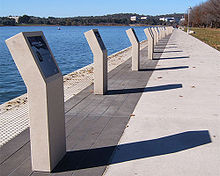
The Walk is situated along a straight section of shoreline on Lake Burley Griffin between the National Library of Australia and the Democracy Avenue Span ( 35°17′42″S 149°07′44″E / 35.295°S 149.129°E / -35.295; 149.129 (Australians of the Yr Walk) Coordinates: 35°17′42″S 149°07′44″E / 35.295°S 149.129°E / -35.295; 149.129 (Australians of the Year Walk) ).
The Walk was opened by the then Prime Minister of Australia John Howard, on Australia Day, 26 January 2006.
In December 2007 announcer Mark McKenna visited the Australian of the Year Walk and interpreted it as a highly symbolic course of national memorial. The empty bollards stretching into the distance especially intrigued him.[35]
These blank plaques – memorials to the future – stand every bit if waiting for the years to pass earlier they can be filled in and become whole. Nevertheless strangely they seem more intriguing than the plaques that precede them. Information technology is possible to imagine the line of bare plaques stretching on endlessly, and their emptiness begs the question: What sort of nation will Australia get over the next few decades?
Australian of the Year Awards as part of Australian society [edit]
The Australian of the Year Awards represent only ane of many ways in which national identity is expressed, but after 50 years they have become a significant part of the ongoing conversation nearly Australia's past, present and future. The awards take besides attracted the interest of foreigners, including BBC correspondent Nick Bryant, who recently observed that the awards programme "offers an intriguing perspective on the Australian national character, which is both reinforcing and revelatory."[36]
An ongoing challenge faced past the NADC is that it is difficult to represent the diversity of Australian achievement when there is only one winner per category in each year. The ongoing debates virtually the numbers of winners from the sciences, arts and sport are show of this. In the time to come, these debates might revolve effectually other problems, including gender residuum and indigenous diversity. Awards Manager Tam Johnston suggests that the value of the awards plan is best measured by consulting the complete list of finalists for each year.[37] In its 2005 Annual Report the NADC included a summary of the 111 finalists honoured nationally, which revealed a remarkable variety of accomplishment and a variety of personal backgrounds.[38] Importantly, the NADC has recently devoted attention to promoting the state finals, which emphasises the wide variety of achievement that is recognised each year.
Not all of the contend and discussion generated by the awards program has been of a serious nature. A more than light-hearted portrait can be establish in the award-winning television receiver satire Nosotros Tin can Be Heroes: Finding The Australian of the Twelvemonth (2005), in which role player Chris Lilley plays v obscure nominees for the Australian of the Twelvemonth award. 1 reviewer suggested that Lilley'south cosmos was both a humorous mockumentary and a serious critique of the awards plan: 'if you desire a evidence that skewers the nation's pretensions and aspirations, while providing laugh-out-loud comedy, this is the real deal.'[39] All five characters have in ane style or another inspired people in their local community, but none of them appears fifty-fifty a remotely suitable choice for Australian of the Year. Although primarily a vehicle for Lilley'south comic talent, We Can Be Heroes is also a bitter critique of what we look for in role models. In dissimilarity, the mag Eureka Street offers a strong endorsement of the awards program'due south potential:[40]
Critics might propose that the awards are manipulated by politicians, or point to the fact that a number of one-time recipients such as Alan Bond afterward fell from grace. Merely the fact remains that the naming of role models is an important customs-building do. Information technology assists young people to set goals for themselves, and encourages older people to take pride in what they take accomplished.
— Eureka Street, January 2007.
The editors of Eureka Street suggest that the awards have been successful in achieving one of the core goals of the National Australia 24-hour interval Council, which is to "promote expert citizenship, values and accomplishment by recognising excellence and service to the communities and the nation".[22]
See also [edit]
- List of Australian of the Year Honor recipients
- List of Young Australian of the Year Award recipients
- List of Senior Australian of the Year Award recipients
- Listing of Australian Local Hero Award recipients
- Orders, decorations, and medals of Commonwealth of australia
References [edit]
- ^ a b "none". The Age. 27 January 1961. p. 2.
- ^ "An Overview". Australian of the Year Awards. Archived from the original on 11 May 2013. Retrieved 21 July 2015.
- ^ Commonwealth of australia Day Council (Victoria), 'Annual Report, 1970 – 1971'
- ^ Whose Australian of the Year?
- ^ a b Interview with Phillip Adams, 16 December 2008
- ^ The Australian 's Australian of the Year
- ^ "Editorial". The Sydney Morning Herald. 31 January 1988. p. 50.
- ^ "Knock-out stupor for Rose, Australian of the Twelvemonth". The Historic period. 18 Jan 1972. p. two.
- ^ "What's your cause?". Australian of the Year . Retrieved 28 January 2018.
- ^ National Portrait Gallery (1996). Australians of the Year (exhibition catalogue). Canberra: National Library of Australia.
- ^ Devine, Miranda (27 January 2016). "Sorry David, but it's the incorrect fight". The Daily Telegraph . Retrieved 29 January 2016.
- ^ Devine, Miranda (31 January 2016). "Miranda Devine: Australian of the Year has become a vehicle for feminist agenda". Daily Telegraph . Retrieved 1 Feb 2016.
- ^ Thomas, Hedley (29 Jan 2016). "Cate McGregor's nomination: Canberra, that's in Queensland". The Australian . Retrieved 29 January 2016.
- ^ "Sober reflections on Australia Day 2016". The Sydney Morning Herald. thirty January 2016. Retrieved 30 January 2016.
- ^ An Overview Archived xi May 2013 at the Wayback Machine, Australian of the Year Awards (quotes the line from Phillip Adams, but no original source is cited)
- ^ "At present Evonne Goolagong is Australian of the Year". The Historic period. eighteen January 1972. p. 2.
- ^ 'Executive Directors Meeting, 26–27 July 1982,' NAA C4688/1, Directors Meeting Folders, Box 13
- ^ NAA C4688/1, Directors Meetings Folders
- ^ 'Public Relations Report, June 1989,' NAA C4688/1, Directors Meetings Folders, Box 14
- ^ National Commonwealth of australia Day Council, Annual Report 2004, Chairman's Message
- ^ Interview with Warren Pearson, 27 March 2009
- ^ a b Charter. Annual Report. National Australia Twenty-four hours Quango. 2007. p. 9.
- ^ National Australia Twenty-four hours Council, Annual Report 2008, 'Master Executive's Officer's Report,'
- ^ State Library of Victoria, Subject File, 'Australian of the Year'
- ^ The Age, fifteen January 1966, p.two
- ^ Kiernan, Ian; Jarratt, Phil. Coming Clean. p. 223.
- ^ "Annual Award for "All-time" Australian". The Sydney Morning Herald. sixteen January 1960. p. 6.
- ^ The Australia Solar day Award presented to Patrick White, Australian of the Year, 1973 (medal R 481), Mitchell Library (Commonwealth of australia)
- ^ Australia 24-hour interval Update, Vol 8 No 2 (1987)
- ^ See NADC Directors Meeting, 25 November 1993, NAA C4688/1 Box fourteen
- ^ Interview with Warren Langley, twenty Feb 2009
- ^ 'Australian of the Year Trophies' Archived 21 July 2008 at the Wayback Machine
- ^ Interview with Kristin McFarlane, 12 January 2009
- ^ "Australians of the Year Walk". National Capital Authority. Retrieved four Feb 2010.
- ^ McKenna, Marking (March 2008). "The Nation Reviewed". The Monthly (32): ten.
- ^ Bryant, Nick (xix January 2009). "'Australian of the Yr' blog". BBC . Retrieved 7 September 2010.
- ^ Interview with Tam Johnston, thirteen November 2008
- ^ Annual Report. National Australia Day Council. 2005. p. 8.
- ^ Hassall, Greg (31 August 2005). "Review: 'We Can Be Heroes: Finding the Australian of the Yr'". The Sydney Morning Herald.
- ^ "Editorial, 'Who makes you proud to exist an Australian?'". Eureka Street: 1–2. 22 January 2007.
External links [edit]
- Australian of the Year website
- Australians of the Year Walk
Source: https://en.wikipedia.org/wiki/Australian_of_the_Year
0 Response to "When Does Endeavour Sponshorship Open Again Australia"
Publicar un comentario