After One Hundred Years Evil Was Once Again Made Flesh.
| Monkey King Sun Wukong | |
|---|---|
 Sun Wukong | |
| In-universe information | |
| Species | Monkey |
| Gender | Male |
| Birthplace | Flowers and Fruit Mount |
| Source | Journeying to the West, 16th century |
| Ability | Immortality, 72 Bian (Morphing Powers), Jin Dou Yun (Deject Surfing), Jin Gang Bu Huai Zhi Shen (Superhuman Durability), Jin Jing Huo Yan (True Sight) |
| Weapon | Ruyi Jingu Bang/Ding Hai Shen Zhen |
| Principal/Shifu/Gang Leader | Xuanzang |
| Sun Wukong | |||||||||||||||||||||||||||||||||||||||||||
|---|---|---|---|---|---|---|---|---|---|---|---|---|---|---|---|---|---|---|---|---|---|---|---|---|---|---|---|---|---|---|---|---|---|---|---|---|---|---|---|---|---|---|---|
| Chinese name | |||||||||||||||||||||||||||||||||||||||||||
| Traditional Chinese | 孫悟空 | ||||||||||||||||||||||||||||||||||||||||||
| Simplified Chinese | 孙悟空 | ||||||||||||||||||||||||||||||||||||||||||
| |||||||||||||||||||||||||||||||||||||||||||
| Burmese name | |||||||||||||||||||||||||||||||||||||||||||
| Burmese | မျောက်မင်း | ||||||||||||||||||||||||||||||||||||||||||
| IPA | [mjaʊʔ mí̃] (Miào Mīn) | ||||||||||||||||||||||||||||||||||||||||||
| Dunganese name | |||||||||||||||||||||||||||||||||||||||||||
| Dungan | Сүн Вўкун | ||||||||||||||||||||||||||||||||||||||||||
| Vietnamese proper name | |||||||||||||||||||||||||||||||||||||||||||
| Vietnamese | Tôn Ngộ Không | ||||||||||||||||||||||||||||||||||||||||||
| Hán-Nôm | 孫悟空 | ||||||||||||||||||||||||||||||||||||||||||
| Thai name | |||||||||||||||||||||||||||||||||||||||||||
| Thai | เห้งเจีย | ||||||||||||||||||||||||||||||||||||||||||
| RTGS | Heng Chia[1] | ||||||||||||||||||||||||||||||||||||||||||
| Korean name | |||||||||||||||||||||||||||||||||||||||||||
| Hangul | 손오공 | ||||||||||||||||||||||||||||||||||||||||||
| Hanja | 孫悟空 | ||||||||||||||||||||||||||||||||||||||||||
| |||||||||||||||||||||||||||||||||||||||||||
| Japanese name | |||||||||||||||||||||||||||||||||||||||||||
| Kanji | 孫悟空 | ||||||||||||||||||||||||||||||||||||||||||
| Hiragana | そん ごくう | ||||||||||||||||||||||||||||||||||||||||||
| Katakana | ソンゴクウ | ||||||||||||||||||||||||||||||||||||||||||
| |||||||||||||||||||||||||||||||||||||||||||
| Malay name | |||||||||||||||||||||||||||||||||||||||||||
| Malay | Sun Wukong | ||||||||||||||||||||||||||||||||||||||||||
| Indonesian name | |||||||||||||||||||||||||||||||||||||||||||
| Indonesian | Sun Get Kong | ||||||||||||||||||||||||||||||||||||||||||
| Khmer name | |||||||||||||||||||||||||||||||||||||||||||
| Khmer | ស៊ុន អ៊ូខុង | ||||||||||||||||||||||||||||||||||||||||||
The Monkey King, known equally Lord's day Wukong (孫悟空/孙悟空) in Mandarin Chinese, is a legendary mythical effigy best known equally one of the master characters in the 16th-century Chinese novel Journey to the Due west ( 西遊記 / 西游记 ) and many subsequently stories and adaptations.[2] In Journeying to the Due west, Dominicus Wukong is a monkey born from a stone who acquires supernatural powers through Taoist practices. Later rebelling against heaven, he is imprisoned under a mountain by the Buddha. After 5 hundred years, he accompanies the monk Tang Sanzang (唐三藏) and two other disciples on a journeying to get back Buddhist sutras from the West (the Indian subcontinent), where Buddha and his followers dwell.
Sun Wukong possesses many abilities. He has amazing strength and is able to support the weight of two heaven mountains on his shoulders while running "with the speed of a meteor".[3] He is extremely fast, able to travel 108,000 li (54,000 km, 34,000 mi) in i somersault. Sun Wukong also acquires the 72 Earthly Transformations, which allow him to access 72 unique powers, including the ability to transform into sundry animals and objects. He is a skilled fighter, capable of defeating the best warriors of heaven. His hair has magical properties, capable of making copies of himself or transforming into various weapons, animals and other things. He besides shows fractional weather manipulation skills and can cease people in place with fixing magic.[4]
History [edit]

As ane of the near enduring Chinese literary characters, the Monkey Rex has a varied background and colorful cultural history. His inspiration comes from an amalgam of Indian and Chinese civilisation. The Monkey King was possibly influenced past the Hindu deity Hanuman, the Monkey-God, from the Ramayana,[5] [6] [vii] via stories passed past Buddhists who traveled to China. The Monkey King'south origin story includes the wind blowing on a stone, whereas Hanuman is the son of the God of Wind. Some scholars believe the character originated from the get-go disciple of Xuanzang, Shi Banto.[8]
His inspiration might have also come from the White Monkey legends from the Chinese Chu kingdom (700–223 BC), which revered gibbons.[5] These legends gave rise to stories and art motifs during the Han dynasty, eventually contributing to the Monkey King effigy.
He may accept likewise been influenced by local folk religion from Fuzhou province, where monkey gods were worshipped long before the novel. This included the three Monkey Saints of Lin Shui Palace, who were once fiends, who were subdued by the goddess Chen Jinggu, the Empress Lin Shui. The three were Dan Xia Da Sheng (丹霞大聖), the Scarlet Face Monkey Sage, Tong Tian Da Sheng (通天大聖), the Blackness Face up Monkey Sage, and Shuang Shuang San Lang (爽爽三聖), the White Confront Monkey Sage.[9] The ii traditional mainstream religions skillful in Fuzhou are Mahayana Buddhism and Taoism. Traditionally, many people exercise both religions simultaneously. However, the roots of local religion dated dorsum centuries. These diverse religions embodied elements such as gods and doctrines from different provincial folk religions and cultures, such as totem worship and traditional legends. Though there are primarily ii main religions in China, since it is so big, unlike folk stories will vary from towns, cities, and provinces with their own myths nigh different deities.[5] Sun Wukong'southward religious condition in Buddhism is often denied past Buddhist monks both Chinese and non-Chinese akin, simply is very welcomed past the general public, spreading its name around the earth and establishing itself as a cultural icon.[5]
Background [edit]
Birth and early life [edit]

Delineation of the Forbidden Temple'south Sunday Wukong equally depicted in a scene in a Peking opera
According to Journey to the West, the Monkey King is born from a strong magic stone that sits atop the Mountain of Flowers and Fruit. This stone is no ordinary rock, however, because it receives the nurture of heaven (yang), which possesses a positive nature, and globe (yin), which possesses a negative nature, and thus is able to produce living beings (according to Taoist philosophies). The stone develops a magic womb, which bursts open one twenty-four hour period to produce a rock egg about the size of a ball.
When the wind blows on the egg, information technology turns into a stone monkey that can already crawl and walk. This origin is probable an innuendo to the Hindu Monkey-god, Hanuman, whose father was the Current of air god. Equally his eyes move, two beams of gilt light shoot toward the Jade palace and startle the Jade Emperor. When he sees the light he orders 2 of his officers to investigate. They report the rock monkey, and that the light is dying downwardly as the monkey eats and drinks. The Jade Emperor believes him to be nothing special.
On the mountain, the monkey befriends various animals and joins a group of other wild monkeys. After playing, the monkeys regularly bathe in a stream. One day, they decide to seek the source of the stream and climb the mountain to a waterfall. They declare that whoever goes through the waterfall, finds the stream's source, and comes out over again will get their king. The stone monkey volunteers and jumps into the waterfall.
He finds a big iron bridge over rushing water, beyond which is a cave. He persuades the other monkeys to jump in as well, and they make it into their abode. Dominicus Wukong and then reminds them of their prior declaration, so they declare him their king. He takes the throne and calls himself Handsome Monkey Male monarch (美猴王). This happiness does not last. When 1 of his older monkey friends dies, the Monkey King is very upset. He decides to strive out of his island on a self fabricated raft, in search of an Immortal to teach him cognition and how to beat death.
He comes ashore and wanders around. Humans see him and flee, uncertain of his monkey humanoid appearance. He takes some clothes that were left out to dry, and continues on foot. His confront hidden by a hood, he travels through towns and sees many examples of human degeneracy and vice. He continues on and into a wood. The Monkey King hears a Woodcutter singing an interesting song, and when questioning the Woodcutter about the origin he learns he was taught it by an Immortal who resides in the forest.
The Monkey King comes to the entrance of a temple of which resides a magical taoist martial artist named Puti Zushi, who initially refuses to permit him in. The Monkey Male monarch waits outside the entrance for many months, refusing to go out. Puti Zushi is impressed with his persistence and allows the Monkey King to enter. Puti Zushi accepts the Monkey King as a student, teaching him all advanced Taoist practices including the mode of Immortality, telling Sunday Wukong it was his destiny to know. Puti Zushi later advises Sunday Wukong never to needlessly bear witness off his skills, for to practise so may encourage others to ask him to teach them. He counsels that if you practise teach them, they may go on to cause trouble, and if you don't teach them, they will resent y'all for it. He so forbids the Monkey King from ever revealing who taught him, and loyal Sun Wukong promises never to reveal who his Master was. With that Sun Wukong awakes back in the forest, realizing all the years of teaching had taken place in some grade of compressed time trance. Later, whenever Sun Wukong is asked well-nigh his powers and skills, he gives an honest answer when maxim that he learned it all in his dreams.
When he returns he learns that a demon called the Demon rex of Confusion is kidnapping the monkeys on the flower-fruit mount to use as slaves, he kills the demon and his minions, and saves the kidnapped monkeys. He as well brings the entire weapon storage of a nearby country for his subjects, just is unable to find a weapon fit for himself. On hearing that Dragon Kings possess many treasures, and in search of a weapon, he travels to the oceans and finds the palace of a Dragon Male monarch. At the archway Sunday Wukong asks for an introduction, only the Dragon Male monarch Ao Guang tells his guards to turn him abroad. Dominicus Wukong barges in anyhow, brushing off protests from the guards, insisting the Dragon Rex must be confused to plough away a fellow Rex. Inside he introduces himself and encourages the Dragon King to requite him a weapon. Quickly realizing Lord's day Wukong is quite formidable, the Dragon King feigns willingness and hospitality, ordering his underlings to bring out weapon after weapon. Sun Wukong tests each weapon, merely none are robust plenty for the Monkey King, who is unhappy at the situation. Sun Wukong then acquires the aureate-banded staff Ruyi Jingu Bang/Ding Hai Shen Zhen (如意金箍棒/定海神针), the stabilizer of the Four Seas and a treasure of Ao Guang, the dragon-king of the Eastern Seas. The Monkey King is the only brute strong enough to wield the staff-like weapon and there is an instant analogousness betwixt them. The golden-banded staff can modify its size, elongate, fly, and attack opponents according to its principal's will. It weighs xiii,500 jīn or 7960 kg. When not wielding the weapon, the Monkey Rex shrinks information technology down to the size of a sewing needle and stores it in his ear.
In addition to taking the magical staff, the Monkey King encourages the Dragon Rex to gift him attire fit for a Male monarch. The Dragon King calls upon the other major Dragon Kings for assistance to source this for Sun Wukong, and they arrive and give Sunday Wukong a golden concatenation mail shirt (鎖子黃金甲), a phoenix-feather cap (鳳翅紫金冠 Fèngchìzǐjinguān), and deject-walking boots (藕絲步雲履 Ǒusībùyúnlǚ). The phoenix-feather cap was one of the treasures of the dragon kings, a circlet of red gold adorned with phoenix feathers. Traditionally, it is depicted as a metal circlet with two striped feathers fastened to the forepart, presumably the signature plumage of the Fenghuang or Chinese phoenix. Sunday Wukong thanks the Dragon Kings and leaves happy.
Upon his return to the mountain, he demonstrates the new weapon to his monkey tribe and draws the attention of other beastly powers, who seek to ally with him. He forms a fraternity with the Balderdash Demon King (牛魔王), the Saurian Demon King (蛟魔王), the Single-horned Demon King (单角魔王), the Roc Demon Male monarch (鵬魔王), the Panthera leo Spirit Rex (獅狔王), the Macaque Spirit King (獼猴王), and the snub-nosed monkey Spirit King (禺狨王).
The Monkey King, now sentenced to decease for extorting the Dragon Kings, then defies Hell'south attempt to collect his soul. He wipes his proper noun out of the Book of Life and Expiry, a drove of books claimed to have every name of every mortal alive and the power to manipulate lifespan, along with the names of all monkeys known to him. The Dragon Kings and the Kings of Hell report him once more to the Jade Emperor.[4] The heavenly regular army uses everything, even trying to erase him from being birthday, merely ultimately fail.
Havoc in Sky [edit]
Hoping that a promotion and a rank amongst the gods will make him more manageable, the Jade Emperor invites the Monkey King to Heaven. The Monkey King believes he is receiving an honorable place as one of the gods as he is told he will be fabricated 'Protector of the Horses' (a fancy term the Heavens coined for a stable-boy), the lowest job in heaven. When he discovers the importance of status in Sky, and how he has been given the everyman position, the Monkey King sets the Cloud Horses costless from the stable, then returns to his ain kingdom and proclaims himself The Peachy Sage, Heaven's Equal.
The Heavens reluctantly recognize his cocky-proclaimed title subsequently Gold Star advises the Jade Emperor against rushing into military action against the 'advised, rude and impudent'[ commendation needed ] monkey, alert that failing to defeat Monkey would harm the reputation of Heaven. Golden Star advises the Jade Emperor to superficially gratify Sun Wukong's vanity while treating him equally a pet, and invite him back to Sky to go on him from causing trouble on earth. The Jade Emperor agrees after Gold Star laughs that, in reality, the fanciful title is a meaningless joke revealing Sunday Wukong's overconfidence and ignorance to the important workings of Heaven.
Sunday Wukong suspects a trap only is happy when Gold Star, acting as an envoy, addresses him as Neat Sage Equal of Sky and presents him with official papers. Gilded Star tells Sun Wukong he's been granted a far more than important position every bit 'Guardian of the Heavenly Peach Garden,' which peach-loving Sun Wukong accepts. Afterwards, when seven heavenly maidens are sent by the Queen Mother Eleven Wangmu to pluck peaches for the Royal Feast, Sun Wukong discovers every important god and goddess has been invited to the banquet except for him. When he tells the maidens he is Cracking Sage Equal of Heaven, the maidens giggle, replying that everyone in Heaven knows he is merely an immortal who tends to the peach garden. The Monkey King's indignation then turns to open defiance.
During the preparations for the Royal Banquet, Lord's day Wukong sneaks in to taste the fine foods and drink royal wine. In a tipsy state, the Monkey Male monarch roams Sky while all the gods and goddesses are on their manner to the banquet. He reaches high levels of the palace that the authorities of Heaven leave unguarded, for they can but be accessed by deities of the highest and purest spiritual power. Upon realizing that he is at the top of the 33 layers of the heavenly palace, Sunday Wukong steals and consumes Laozi'south Pills of Immortality and 11 Wangmu'due south Peaches of Immortality, takes the balance of the Jade Emperor's royal wine, and then escapes back to his kingdom in preparation for his rebellion.
The Jade Emperor refuses to have Gilded Star's counsel to detect another peaceful way to bargain with Sun Wukong and orders his forces to mobilize. Laughing continuously and fully enjoying himself, and with a combination of martial prowess, guile, and quick-witted creative responses to many different types of powerful Heavenly weapons used against him, the Monkey King single-handedly defeats the Army of Heaven's 100,000 angelic warriors, all 28 constellations, Nezha, and all of the Four Heavenly Kings. And so Guanyin, the Boddhisattva of Mercy and her disciple Muzha/Moksha get in. Guanyin sends Muzha to audit the state of affairs and fight Dominicus Wukong. Muzha is defeated, and so Guanyin suggests the Jade Emperor'southward nephew Erlang Shen fight Wukong. Wukong and Erlang are evenly matched and somewhen both plough into terrifying figures, which scares Wukong'due south monkey regular army away. Dominicus Wukong is disheartened and turns into a fish to run away, and so both of them keep shapeshifting to turn into more powerful things than the other, finally Laozi throws his Diamond Jade ring at Wukong from behind while he is fighting, knocking him senseless and enabling Erlang to bind him up.
After several failed attempts at execution, Sun Wukong is locked into Laozi's eight-manner trigram crucible for 49 days in order to be distilled into an elixir past samadhi fires; this volition permit Laozi to regain his pills of longevity. The fire of the crucible is hot enough to burn beings of so much unspeakable ability, they rival Buddha himself.
Yet, when the cauldron is opened 49 days later, the Monkey Rex jumps out - having survived past hiding in a corner marked past the wind trigram, where there was less burn. In fact, the heat from the samadhi fires have reinforced his actual frame, making him stronger than e'er before and impervious to greater impairment. The estrus too gives him a new ability; the Monkey King can at present to recognize evil with his new huǒyǎn-jīnjīng (火眼金睛) (lit. "golden-gaze"). Sun Wukong then proceeds to destroy the crucible and makes his way to Heaven's main chamber to face up the Jade Emperor and his senior advisors.
Imprisonment [edit]
The Jade Emperor and the authorities of Heaven appeal to the Buddha, who arrives from his temple in the West in person. After listening to Lord's day Wukong, he made a case that he should be the new Jade Emperor, the Buddha makes a bet that the Monkey Male monarch cannot escape from his palm. The Monkey King smugly accepts the bet. He leaps and flies to the end of the world. Seeing nothing at that place but five pillars, the Monkey King believes that he has reached the ends of universe. To show his trail, he marks a colonnade with a phrase declaring himself the Great Sage Equal to Heaven and urinates on a colonnade. He and so leaps dorsum and returns to Buddha's palm to merits his victory in winning the bet. Sun Wukong is then very surprised to find that the five "pillars" he found are merely fingers of the Buddha's mitt, finding it impossible to believe. When the Monkey Male monarch tries to escape the palm, Buddha turns his hand and brings down a rockfall, sending Sun Wukong hurtling back downwards to earth. The rocks form a mountain on top of Sun Wukong. Before the Monkey King can lift it off, the Buddha seals him there, using a paper talisman begetting the mantra, Om Mani Padme Hum, in gold letters. The Monkey King remains imprisoned in stocks for 5 hundred years to 'larn patience and humility,'[ citation needed ] with only his head and hands protruding from the base of the mountain. The Buddha arranges two earth spirits to feed the Monkey King iron pellets when he is hungry, and molten copper when he is thirsty.[iv] Ability the equivalent of the Buddha's is given to all Buddhas, pregnant that they all accept the Buddha'south abilities and power, but only Buddha has the key to disable their power if they disobey.
Disciple to Tang Sanzang [edit]

Sun Wukong with Tang Sanzang

Lord's day Wukong fighting a wind demon
Five hundred years afterward, the Bodhisattva Guanyin searches for disciples to protect a pilgrim on a journey to the West to retrieve the Buddhist sutras. In the hearing of this, the Monkey King offers to serve the pilgrim, Tang Sanzang, a monk of the Tang dynasty, in exchange for his freedom after the pilgrimage is complete. Understanding Sunday Wukong will be difficult to control, Guanyin gives Tang Sanzang a souvenir from the Buddha: a magical circlet which, in one case the Monkey Male monarch is tricked into putting information technology on, tin never be removed. When Tang Sanzang chants a certain sutra, the band volition tighten and crusade an unbearable headache. To be off-white, Guanyin gives the Monkey King three special hairs, only to be used in dire emergencies. Under Tang Sanzang's supervision, the Monkey King is allowed to journey to the W.
Throughout the novel, the Monkey King faithfully helps Tang Sanzang on his journey to India. They are joined by "Pigsy" (猪八戒 Zhu Bajie) and "Sandy" (沙悟浄 Sha Wujing), both of whom back-trail the priest to absolve for their previous crimes. Tang Sanzang's safety is constantly under threat from demons and other supernatural beings, also as bandits, equally they believe that by eating Tang Sanzang's flesh, one volition obtain immortality and not bad ability. The Monkey Rex oft acts as Tang Sanzang's babysitter to combat these threats. The group encounters a series of eighty-i tribulations before accomplishing their mission and returning safely to China. During the journey, the Monkey Rex learns about virtues and the teachings of Buddhism. There, the Monkey King attains Buddhahood, becoming the "Victorious Fighting Buddha" (Dòu-zhànshèng-fó (鬥戰勝佛)), for his service and strength.[iv] We also come across that Monkey king likewise knows nearly the fate of Tang Sangzang and as well of his knowledge in pretty much everything, as at three occasions he knew that the monk was supposed to suffer and he as well cures a rex who had been sick for many years, and he knows properties of herbs no one knew of.
Names and titles [edit]
Sun Wukong is known/pronounced as Suen Ng-hung in Cantonese, Son Gokū in Japanese, Son Oh Gong in Korean, Sun Ngō͘-Khong in Minnan, Tôn Ngộ Không in Vietnamese, Sung Ghokong or Sung Gokhong in Javanese, Lord's day Ngokong in Thai, "Wu Khone" in Arakanese and Sun Gokong in Malay and Indonesian.
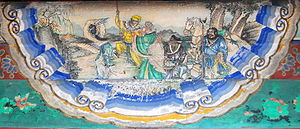
Painted mural depicting Sun Wukong (in yellow) and other main characters of the novel
Listed in the order that they were acquired:
- Shí Hóu (石猴)
- Meaning the "Stone monkey." This refers to his physical essence, existence born from a sphere of stone after millennia of incubation on the Blossom Mountains/Flower-Fruit Mountain.
- Měi Hóuwáng (美猴王)
- Meaning "Handsome Monkey-King," Houwang for brusk. The adjective Měi means "cute, handsome, pretty". It as well means "to exist pleased with oneself," referring to his ego. Hóu ("monkey") also highlights his "naughty and impish" character.
- Sūn Wùkōng (孫悟空)
- The name given to him by his kickoff primary, Patriarch Bodhi (Subodhi). The surname Sūn was given every bit an in-joke about the monkey, every bit monkeys are also called húsūn (猢猻), and tin can mean either a literal or a figurative monkey (or a macaque). The surname sūn (孫) and the "monkey" sūn (猻) only differ in that the latter carries an extra "dog" (quǎn) radical to highlight that 猻 refers to an animal. The given name Wùkōng means "awakened to emptiness," sometimes translated as Aware of Vacuity.
- Bìmǎwēn (弼馬溫)
- The title of the keeper of the Heavenly Horses, a punning of bìmǎwēn (避馬瘟; lit. "avoiding the horses' plague"). A monkey was often put in a stable, as people believed its presence could foreclose the horses from catching illness. Sun Wukong was given this position by the Jade Emperor later his outset intrusion into Heaven. He was promised that information technology was a skillful position to have and that he would be in the highest position. Afterward discovering it was one of the lowest jobs in Heaven, he became aroused, smashed the entire stable, set the horses free, and then quit. From then on, the title bìmǎwēn was used past his adversaries to mock him.
- Qítiān Dàshèng (齊天大聖)
- Meaning "The Keen Sage, Heaven's Equal." Wùkōng took this title suggested to him by i of his demon friends, after he wreaked havoc in heaven people who heard of him chosen him Smashing Sage (Dàshèng, 大聖). The title originally holds no power, though information technology is officially a loftier rank. The Jade Emperor after granted the championship the responsibility to guard the Heavenly Peach Garden, keeping Sun Wukong busy so he would not make trouble.
- Xíngzhě (行者)
- Meaning "austere," it refers to a wandering monk, a priest'due south servant, or a person engaged in performing religious austerities. Tang Sanzang calls Wukong Sūn-xíngzhě when he accepts him as his companion. This is pronounced in Japanese as gyōja (making him Son-gyōja).
- Dòu-zhànshèng-fó (鬥戰勝佛)
- "Victorious Fighting Buddha." Wukong was given this name once he ascended to Buddhahood at the cease of the Journey to the West. This name is as well mentioned during the traditional Chinese Buddhist evening services, specifically during the 80-eight Buddha's repentance.
- Líng-míngdàn-hóu (靈明石猴)
- "Intelligent Rock Monkey." Wukong is revealed to be one of the four spiritual primates that do not belong to any of the ten categories that all beings in the universe are classified under. His fellow spiritual primates are the Six-Eared Macaque (六耳獼猴) (who is one of his antagonists in the main storyline), the Red-Bottomed Horse Monkey (赤尻馬猴), and the Long-Armed Ape Monkey (通臂猿猴) (neither of who make actual appearances, only mentioned in passing by the Buddha). The powers and abilities of each are equal to that of the others.
- Sūn Zhǎnglǎo (孫長老)
- Used every bit an honorific for a monk.
In add-on to the names used in the novel, the Monkey King has other names in unlike languages:
- Kâu-chê-thian (猴齊天) in Minnan (Taiwan): "Monkey, Equal of Heaven."
- Maav lau1 zingi (馬騮精) in Cantonese (Hong Kong and Guangdong): "Monkey Imp" (Chosen so by his enemies).
Immortality [edit]
Sun Wukong gained immortality through 7 different means, which together made him 1 of the well-nigh immortal and invincible beings in all of creation.
Disciple to Puti Zushi [edit]
After feeling down about the future and decease, Wukong sets out to observe the immortal Taoist patriarch Puti Zushi to learn how to be immortal. There, Wukong learns spells to grasp all five elements and cultivate the way of immortality, as well every bit the 72 Earthly Transformations. Subsequently seven years of training with the sage, Wukong gains the secret formula to immortality. It is noted that the Courtroom of Heaven does not approve of this method of immortality.[10]
Book of Mortals [edit]
In the centre of the night, Wukong'south soul is tied up and dragged to the World of Darkness. He is informed there that his life in the human being globe has come to an terminate. In anger, Wukong fights his fashion through the Globe of Darkness to complain to "The Ten Kings," who are the judges of the dead. The Ten Kings try to address the complaint and calm Wukong by proverb many people in the globe have the same name and the fetchers of the dead may have gotten the wrong proper name. Wukong demands to see the register of life and death, so scribbles out his name, thus making him untouchable by the fetchers of death. It is because Wukong has learned magic/magical arts as a disciple to Puti Zushi that he can scare the Ten Kings, demanding from them the book of mortals and removing his proper name, thus making him even more immortal. After this incident, the X Kings mutter to the Jade Emperor.[10]
Peach of Immortality [edit]
Soon afterward the Ten Kings complain to the Jade Emperor, the Court of Heaven appoints Sun Wukong equally "Keeper of the Heavenly Horses," a fancy name for a stable boy. Angered past this, Wukong rebels and the Havoc in Sky begins. During the Havoc in Heaven, Wukong is assigned to exist the "Guardian of the Heavenly Peach Garden." The garden includes three types of peaches, each of which grant over iii,000 years of life. The offset type blooms every iii thousand years; anyone who eats information technology will become immortal, and their body will get both low-cal and potent. The second blazon blooms every 6 chiliad years; anyone who eats it will be able to fly and enjoy eternal youth. The tertiary blazon blooms every nine thousand years; anyone who eats information technology will get "eternal every bit heaven and globe, every bit long-lived equally the dominicus and moon." While serving as the guardian, Wukong does not hesitate to eat the peaches, thus granting him immortality and the abilities that come up with the peaches. If Wukong had not been appointed as the Guardian of the Heavenly Peach Garden, he would not have eaten the Peaches of Immortality and would not accept gained another level of immortality.[10]
Heavenly Vino [edit]
Considering of Wukong's rebellious antics, Wukong is not considered as an of import celestial deity and is thus not invited to the Queen Female parent of the West'due south imperial banquet. After finding out that every other important deity was invited, Wukong impersonates one of the deities that was invited and shows up early on to see why the banquet is of import. He immediately is distracted by the aroma of the wine and decides to steal and potable information technology. The heavenly wine has the power to turn anyone who drinks it to an immortal.[10]
Pills of Longevity [edit]
While drunk from the heavenly wine, Wukong stumbles into Laozi'due south alchemy lab, where he finds Laozi'south pills of longevity, known equally "The Immortals' Greatest Treasure." Filled with marvel near the pills, Wukong eats a gourd of them. Those who swallow the pills will get immortal. If Wukong had not been drunk from the heavenly wine, he would non take stumbled into Laozi's alchemy lab and eaten the pills of longevity.[10]
Aftermath of Immortality [edit]
Following Wukong's three cause-and-event methods of immortality during his time in sky, he escapes dorsum to his domicile at the Mountain of Flowers and Fruit. The Court of Heaven finds out what Wukong has washed and a battle to capture Wukong ensues. Due to the five levels of immortality Wukong has achieved, his body has become nearly invincible and thus survives the multiple execution attempts by sky. In the notable final execution, Wukong was placed inside Laozi's furnace in hopes that he volition be distilled into the elixir of the pills of immortality. Wukong survives 49 days of the samadhi fire in Laozi's furnace and gains the ability to recognize evil; meanwhile, beingness refined in the crucible extracts yet more of the impurities of mortality and leaves him with another immortality. In desperation, the Court of Heaven seeks aid from Buddha, who finally imprisons Wukong under a mountain. Wukong'due south immortality and abilities ultimately come into apply subsequently Guanyin propose him to be a disciple to Tang Sanzang in the Journey to the West. In that location, he protects Sanzang from the evil demons who endeavour to swallow Sanzang to gain immortality. Wukong's ain immortality protects him from the various ways the demons endeavour to impale him, such every bit beheading, disemboweling, poisoning, and humid oil.[ten]
Onetime during the journeying, Wukong and his companions obtain Ginseng fruit (人參果; Man-fruit), a fruit even rarer and more than powerful than the Peaches of Immortality, every bit only 30 of them will abound off one particular tree only found on the Longevity Mountain (萬壽山) every 10,000 years. While one aroma tin can grant 360 years of life, consuming i will grant another 47,000 years of life.
In improver to all of the immortality-granting wines and medicines that the Monkey Male monarch had consumed while in sky, upon reaching the Buddha's temple, pilgrims were provided with Buddhist equivalents of such foods, therefore making Dominicus Wukong even more immortal.
In Xiyoubu [edit]
The brief satirical novel Xiyoubu (西遊補, "Supplement to the Journey to the W," c. 1640) follows Sun as he is trapped in a magical dream world created by the Qing Fish Demon, the embodiment of desire (情, qing). Sun travels back and forth through time, during which he serves as the offshoot King of Hell and judges the soul of the recently dead traitor Qin Hui during the Song dynasty, takes on the appearance of a cute concubine and causes the downfall of the Qin dynasty, and faces King Paramita, one of his 5 sons born to the demoness Princess Iron Fan,[xi] on the battlefield during the Tang dynasty.[12] The events of the Xiyoubu have identify between the finish of chapter 61 and the beginning of chapter 62 of Journeying to the West.[xiii] The writer, Tong Yue (童說), wrote the book because he wanted to create an opponent—in this case, desire-itself—that Sun could non defeat with his not bad force and martial skill.[14]
Influence [edit]

- Some scholars believe the character of the Monkey Male monarch may have originated from the outset disciple of Xuanzang, Shi Banto.[8]
- Fujianese folk religion had already worshipped a number of monkey "great sages" in their lore which might have influenced the author aslope other legends of gods and demons across Communist china.
- The Hindu deity Hanuman from the Ramayana is considered by some scholars to be a origin for Sun Wukong.[5]
- In The Shaolin Monastery (2008), Tel Aviv University Professor Meir Shahar claims that Sun influenced a fable concerning the origins of the Shaolin staff method. The legend takes identify during the Red Turban Rebellion of the Yuan dynasty. Bandits lay siege to the monastery, merely it is saved by a lowly kitchen worker wielding a long fire poker equally a makeshift staff. He leaps into the oven and emerges every bit a monstrous giant big enough to stand up astride both Mount Song and the imperial fort atop Shaoshi Mount (which are five miles autonomously). The bandits flee upon seeing him. The Shaolin monks afterward realize that the kitchen worker was the Monastery's local guardian deity, Vajrapani, in disguise. Shahar compares the worker's transformation in the stove with Lord's day Wukong's time in Laozi'southward crucible, their utilize of the staff, and the fact that Sun Wukong and his weapon can both grow to gigantic proportions.[xv]
- Chinese DAMPE satellite is nicknamed after Wu Kong. The proper name could be understood as "empathize the void" literally, relates to the undiscovered night matter.[16]
Manga and animation [edit]

Cartoon-manner models of Monkey Rex on the streets of Lianyungang
- The character of Son Goku in Dragon Ball is based on Sun Wukong, every bit attested by his monkey tail, staff, and name (which is simply the Japanese reading of the same name in Chinese: "孫悟空").[17]
- The manga-anime series Saiyuki Sun Wukong analogue as well uses the Japanese reading Son Goku.
- The graphic symbol of Mushra in the Toei Blitheness Anime Shinzo is based on Sun Wukong, retaining the grapheme'southward gilt headband and telescoping staff.
- The character of Kongo in Monkey Magic is based on Dominicus Wukong.
- In The God of Loftier Schoolhouse, the protagonist Mori Jin's is based on the God Sun Wukong.[18]
- The character Sun Wukong in RWBY is based on the lore; but instead of using his hair to make the clones, he can brand the clones using RWBY'southward magic organization.[19]
- The graphic symbol of Dominicus Wukong, explicitly said to be the trickster of legend, plays a major role in the DreamWorks animated series Kung Fu Panda: The Paws of Destiny.
- The principal character of Jesse Dart Spaceketeers is based on the monkey king in Strength V, where he wears a gilded band around his head that is controlled by the princess, and which may induce agony every bit well. The gold band is likewise his principal weapon, a long javelin that decreases in size and shape.
- In 2021, Sunrise Inc. has released an blitheness series SD Gundam World Heroes,[twenty] under the SD Gundam franchise. in which feature Sun Wukong as a protagonist forth with other mythical characters in novels.
Video games [edit]
- In Lunar: Eternal Blue (1994), according to scenario writer Kei Shigema, the concept of an oppressive god came from the image of Sun Wukong being unable to escape from the gigantic palm of the Buddha.[21] Shigema stated that it "was a pic showing the arrogance of a god who is proverb, 'In the end, you pathetic humans are in my easily.' The moment I understood that, I thought, 'Oh, I definitely want to do this,' it'll definitely match perfectly. Then nosotros used information technology just similar that."[22]
- In Dota 2, a multiplayer online boxing loonshit (MOBA) from Valve, there is a hero called Sunday Wukong, the Monkey King. His backstory within Dota also roughly follows the story of Journey to the Due west.[23]
- In Heroes of Newerth, a MOBA by S2 Games, there is a hero named Monkey King.[24]
- Sun Wukong is a playable character in HiRez Studio'south MOBA, Smite. Wukong has abilities based on his staff shifting size, his ability to transform, and his ability to duplicate.[25]
- In Heroes of the Storm, Blizzard'south crossover MOBA, a legendary skin the Monkey Male monarch for a hero chosen Samuro is based on Sun Wukong.[26]
- League of Legends, a MOBA from Riot Games, has a champion called Wukong, the Monkey Male monarch.[27]
- In LittleBigPlanet (2008), the Monkey King appeared equally a downloadable costume for the game.[28]
- In Warframe, a Digital Extremes shooter, Sun Wukong appears every bit one of the playable characters, inheriting his signature staff, cloning ability, flight ability and immortality techniques.[29]
- In Mobile Legends: Bang Bang, a MOBA from Moonton, the character Sun is based on Sun Wukong.[xxx]
- In Laurels of Kings, a MOBA from Tencent Gaming, the character Dominicus Wukong is based on the Monkey King.[31]
- In Black Myth: Wukong, an upcoming 3rd-person action/RPG game featuring Souls-like gameplay by Chinese indie developer Game Science.[32]
- Dominicus Wukong is one of twelve mythological heroes that civilizations can summon in Civilization VI's Heroes and Legends Way.[33]
- In Totally Accurate Boxing Simulator, the Monkey King is a playable unit from the dynasty faction. He wields a staff that changes in size, and can create copies of himself.
- In Fortnite, Sun Wukong appears every bit a playable graphic symbol as part of the Wukong ready, which comprises the character, his Jingu Bang, and Royale Flags.[34]
- In Asura's Wrath, the titular graphic symbol has some elements of Wukong. He rages against his fellow gods for betraying him, ends up trapped under a mountain for 500 years, and somewhen confronts an evil Buddha chosen Chakravartin.
- In Bookworm Adventures Vol.2, the Monkey King is a companion gained automatically by completing chapter seven of Book five of the Adventure style.[35]
See also [edit]
- Category: Locations in Chinese mythology
- List of media adaptations of Journeying to the West
- Monkey King Festival
- Birthday of the Monkey God
- Dafo Temple (Zhangye) – contains a Qing Dynasty mural featuring Monkey and other characters from the novel)
References [edit]
- ^ (from Hokkien pronunciation of "行者" (Hêng-chiá))
- ^ Shahar, Meir (2008). The Shaolin monastery: History, organized religion, and the Chinese martial arts. Honolulu: University of Hawaii Press. pp. 92–93. ISBN9780824831103.
- ^ Wu Cheng'en and Anthony Yu. The Journey to the West: Vol. 2 (Chicago, Illinois: University of Chicago Press), 108-109.
- ^ a b c d Wu Cheng'en (1500–1582), Journeying to the W, Translated by Foreign Languages Press, Beijing 1993.
- ^ a b c d e Hera S. Walker, "Ethnic or Foreign?: A Await at the Origins of the Monkey Hero Sun Wukong", Sino-Platonic Papers, 81 (September 1998)
- ^ Wendy Doniger. "Hanuman (Hindu mythology)". Encyclopædia Britannica . Retrieved 22 February 2010.
- ^ Ramnath Subbaraman, "Beyond the Question of the Monkey Imposter: Indian Influence on the Chinese novel The Journey to the West", Sino-Platonic Papers, 114 (March 2002)
- ^ a b "CCTV-大唐西游记". www.cctv.com.
- ^ "齊天大聖vs.丹霞大聖 @台灣多奇廟 - 探路客 部落格". world wide web.timelog.to (in Chinese (Taiwan)). Retrieved 24 March 2021.
- ^ a b c d eastward f Wu, Cheng−en (1982). Journey to the West. Translated past Jenner, William John Francis. Beijing: Foreign Languages Printing. ISBN0835110036.
- ^ Rex Paramita is the but son to make an appearance and to be called past proper name in the novel. These sons did not originally appear in Journeying to the W.
- ^ Tong, Yue, Shuen-fu Lin, Larry James Schulz, and Chengẻn Wu. The Belfry of Myriad Mirrors: A Supplement to Journeying to the W. Michigan classics in Chinese studies, 1. Ann Arbor: Centre for Chinese Studies, The University of Michigan, 2000
- ^ Tong, The Belfry of Myriad Mirrors, p. v
- ^ Tong, The Belfry of Myriad Mirrors, p. 133
- ^ Shahar, Meir. The Shaolin Monastery: History, Religion, and the Chinese Martial Arts. Honolulu: Academy of Hawai'i Printing, 2008 (ISBN 0-8248-3110-one)
- ^ "China's new Monkey King gear up for journeying into space". Xinhua. 16 December 2015. Retrieved 27 November 2017.
- ^ "From Dominicus Wukong to Son Goku: Mythology in Graphic Novels – The Graphic Novel".
- ^ "Episode 11: "lay/key"". アニメ「THE GOD OF Loftier SCHOOL ゴッド・オブ・ハイスクール」公式サイト . Retrieved fourteen September 2020.
- ^ "RWBY episodes". roosterteeth . Retrieved 27 Nov 2017.
- ^ "SD GUNDAM Earth HEROES | GUNDAM.INFO | The official Gundam news and video portal". SD GUNDAM WORLD HEROES | GUNDAM.INFO | The official Gundam news and video portal . Retrieved 1 July 2021.
- ^ Game Arts (1997). Lunar I & Two Official Design Cloth Collection. Softbank. p. 90. ISBN4-89052-662-5.
- ^ Game Arts (1997). Lunar I & II Official Design Material Drove. Softbank. p. 91. ISBN4-89052-662-v.
- ^ "Dota 2". Monkey Male monarch . Retrieved 4 February 2019.
- ^ "Heroes of Newerth - Hero - Monkey King". Retrieved 10 February 2020.
- ^ "Mixer_Icon_White". Smitegame.com. Retrieved 4 October 2019.
- ^ Archived at Ghostarchive and the Wayback Auto: Heroes of the Tempest Samuro Monkey King Skin proclamation 风暴英雄 猴王(孙悟空)萨穆罗皮肤 , retrieved ane October 2019
- ^ "THE MONKEY King WUKONG". na.leagueoflegends.com. Archived from the original on 3 September 2021. Retrieved one October 2019.
- ^ Spaff (xvi Apr 2009). "The Monkey King – Free costume out at present". Media Molecule. Archived from the original on 21 November 2010. Retrieved one Baronial 2019.
- ^ "Warframe: Wukong". Warframe . Retrieved 12 December 2019.
- ^ "Monkey King: Hero is Back is not the groundbreaking experience it could take been". Abacus. 28 October 2019.
- ^ "王者荣耀孙悟空-王者荣耀官网网站-腾讯游戏". pvp.qq.com . Retrieved vii February 2020.
- ^ Black Myth: Wukong - Everything We Know About Gameplay, Release Appointment, and More than - IGN, 9 February 2020, retrieved xi October 2020
- ^ Civilization VI - November 2022 DLC | New Frontier Laissez passer
- ^ "Wukong Archives". Pro Game Guides . Retrieved 10 July 2021.
- ^ "Destructoid Review: Bookworm Adventures 2". Destructiod. 5 August 2009. Retrieved i February 2022.
External links [edit]
 | Wikimedia Commons has media related to Lord's day Wukong. |
- Lord's day Wukong Grapheme Contour A detailed graphic symbol contour of Sun Wukong, with character history, listing and explanations of his various names and titles, detailed information on his weapon, abilities, powers, and skills, and personality.
- Story of Dominicus Wukong with manhua
- Lord's day Wukong's entry at Godchecker is a tongue-in-cheek accept on the Bang-up Sage.
- (in Chinese) Journey to the Westward
Source: https://en.wikipedia.org/wiki/Monkey_King
0 Response to "After One Hundred Years Evil Was Once Again Made Flesh."
Publicar un comentario